
Today marks the comment deadline for the Federal Reserve’s proposed revisions to its payment system risk policy. It sounds like bureaucratic plumbing, but it is the frontline of a multi-year war over payment rail architecture. Fintechs are lobbying for direct access to core clearing infrastructure, while incumbent banks are demanding heightened oversight to protect their entrenched institutional tollbooths.
The Master Account Monopoly
The Fed’s proposed special-purpose "Payment Accounts" would allow eligible non-bank institutions to connect to Fedwire and FedNow, but they explicitly exclude access to FedACH and intraday credit. This omission is the crux of the structural fight. Without FedACH, fintech platforms remain entirely dependent on intermediary sponsor banks for payroll, bill pay, and high-volume transaction settlement.
This architecture forces digital wallets and super apps to hand over a slice of their unit economics to traditional banks just to move money. Banks argue this friction is necessary to ensure comparable regulatory supervision and prevent a drain on deposits. For fintechs, however, it represents an existential cap on margin expansion and operational velocity.
Stripping the Sponsor Bank Tax
The secular shift in consumer finance is moving rapidly toward embedded super apps, transforming the smartphone into a universal financial remote control . This modernization is radically reducing payment friction and opening avenues for massive scale, with embedded finance projected to represent a $320 billion revenue opportunity by 2030 .
Chart failed: Insufficient price history for one or more of: PYPL, SQ, SOFI
That scale ultimately relies on underlying infrastructure. When companies like PayPal or Block process transactions, the speed and cost of settlement dictate their free cash flow. If they must continuously route through legacy banking infrastructure, their dual-sided ecosystems—bridging merchant terminals and consumer peer-to-peer payments—bleed basis points on every swipe. The momentum surrounding tokenized finance is only accelerating this urgency, as agentic commerce emerges as a compelling frontier for the industry .

Near-Term Transmission Channels
While the regulatory battle over Fed access will play out over years, the immediate read-through for this sector lands in the upcoming earnings season. The market is aggressively pricing the tension between transaction volume growth and the cost of funding those transactions across the Super-App & Embedded Finance landscape.
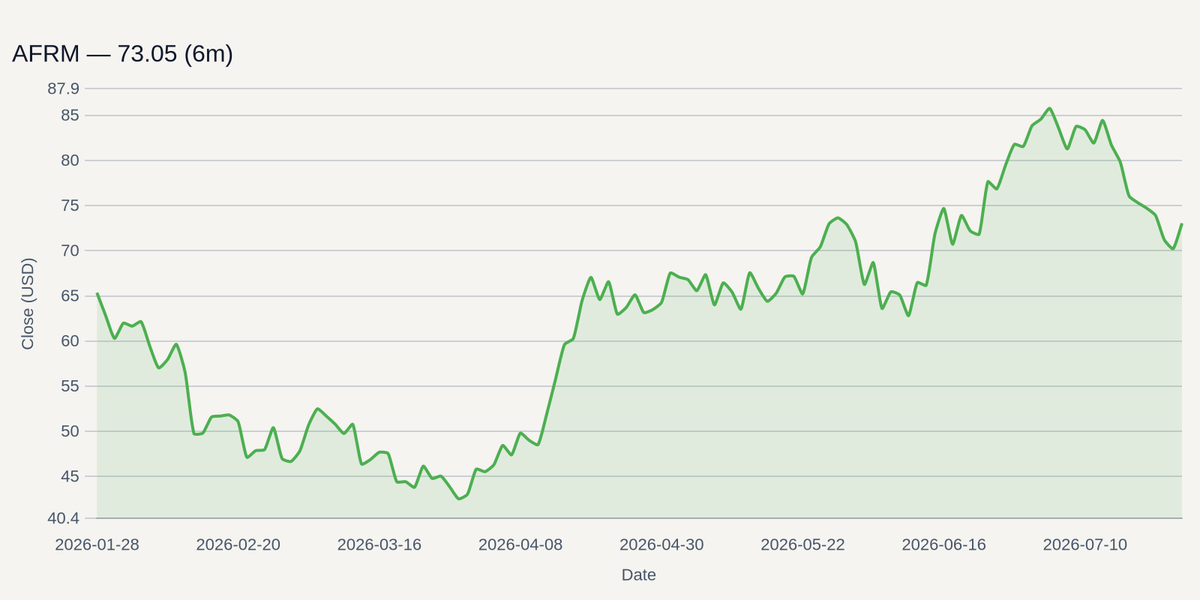
Affirm serves as a prime example, stepping to the plate for its Q4 readout in late August. With shares trading at a premium multiple, the bar is elevated. If Affirm demonstrates robust gross merchandise volume (GMV) growth above 30% alongside stable credit losses, our modeled bull scenario points toward an $82.50 target. Conversely, if funding costs bite or demand slows in a 3.6% Fed funds environment, multiple compression could drag the stock back toward $67.00.
PayPal reports tomorrow, July 28. Following a 25% rally since May lows, the market needs concrete evidence that unbranded checkout monetization and aggressive cost-savings initiatives are actually materializing. A clean margin beat could push shares toward the $61.50 band, but failure to deliver on operating leverage leaves the name vulnerable to a sharp reset. The payment rails are modernizing, but the gatekeepers are not surrendering their tollbooths quietly.