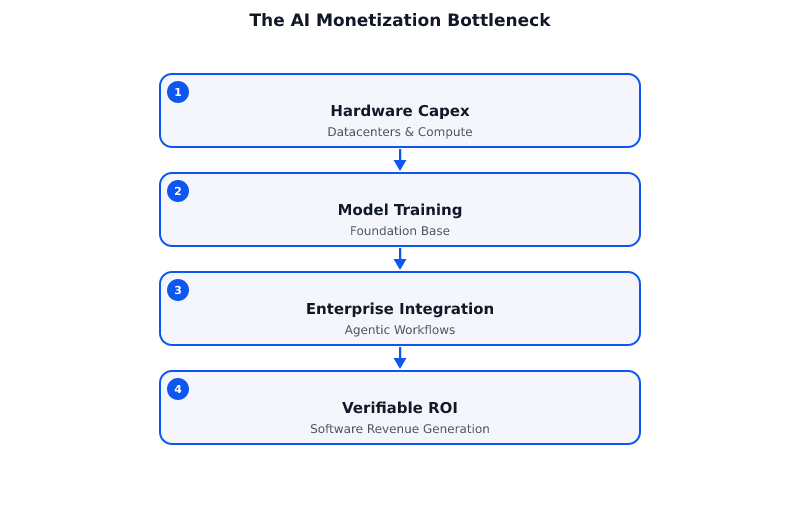
The artificial intelligence sector is violently transitioning from a capital expenditure buildout to a brutal "show me the money" software monetization phase. With the Nasdaq slipping to start the week and bond yields surging, capital markets are actively repricing the enterprise software layer . The fundamental disconnect is structural: the massive computing expenditures underwriting this boom require a corresponding explosion in verifiable enterprise return on investment, and institutional patience is wearing incredibly thin .
The Hardware Underwriting Trap
Right now, the AI boom relies on an assumption of sustained, aggressive capital spending. But as institutional bears are loudly pointing out, it only takes one season of software revenue disappointing that hardware underwriting for the whole cap table to shift. Hyperscaler capital expenditures require massive software application revenues just to deliver acceptable hurdle rates .
If enterprise software deployment lags, corporate boards predisposed to redeploy capital toward the highest-conviction bets will simply conclude that the macro environment has shifted, pulling the rug out from under future compute orders.
Cannibalizing the Legacy Seat
The mechanics of this software transition are inherently margin-dilutive for traditional business models. Moving from per-seat SaaS licensing to consumption-based autonomous agents introduces serious friction. You are essentially asking enterprise vendors like CRM and NOW to navigate lower gross margins on inference delivery while risking the cannibalization of their highly predictable legacy seat counts .
To make matters worse, emerging regulatory compliance frameworks and sovereign data governance mandates are sharply increasing the operational overhead required to roll out these large-scale agents . Corporate IT departments are tapping the brakes to ensure their data isn't leaking into public models, extending the sales cycle precisely when vendors desperately need to show immediate traction.

Pricing the Enterprise Workflow Race
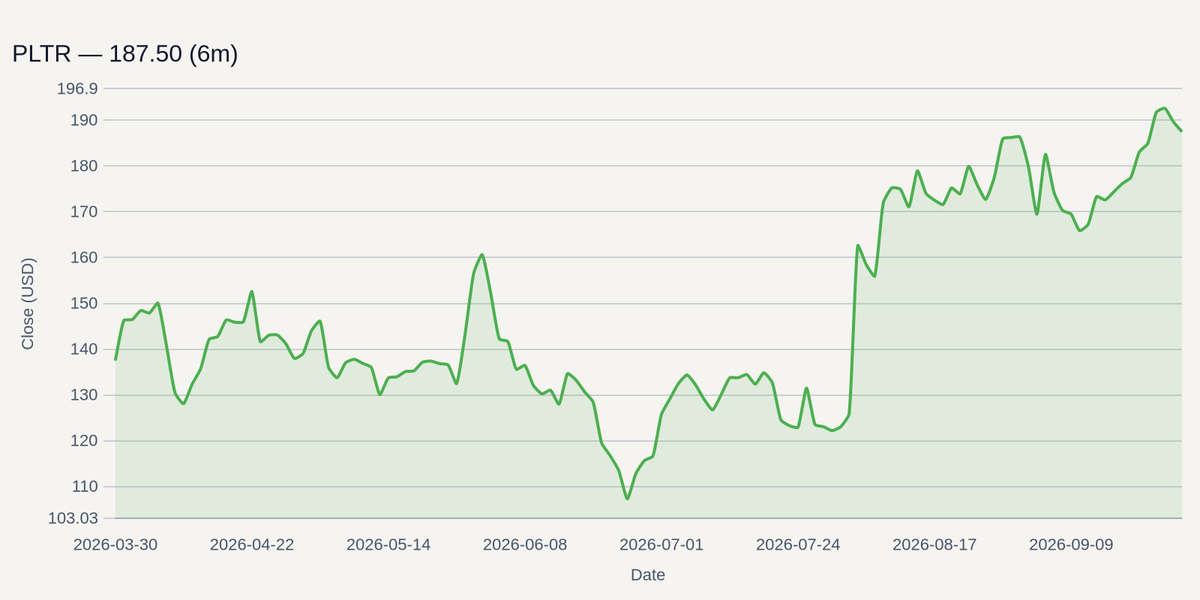
This friction brings us to the actual application layer, where market sentiment is actively bifurcating. Investors are penalizing multiple expansion for software vendors who cannot prove immediate revenue inflection . Take PLTR, for example. Trading at a blistering forward multiple, the margin for error heading into their early November earnings is effectively zero. The company's U.S. Commercial segment must convert Artificial Intelligence Platform (AIP) pilots into massive, sticky contracts, or the stock risks a severe multiple contraction.
Similarly, NOW is racing to convert customers to its premium Now Assist Pro-Plus SKUs heading into the federal fiscal year-end. Historical software guidance cohorts show steady upward momentum, but at a 65x trailing P/E, there is no room for a net-new ACV miss. The pressure is also mounting on full-stack giants like MSFT and ORCL to prove their massive Azure and OCI infrastructure builds are translating directly into durable Copilot and dedicated model hosting revenues rather than just one-off experiments.
The Q3 Execution Gauntlet
The upcoming Q3 enterprise software earnings season (stretching through November) serves as the ultimate reality check. The market will demand granular updates on generative AI revenue contributions, agentic pricing uptake, and net expansion rates.
If data cloud providers like SNOW and CRM can demonstrate that consumption monetization through their new AI engines is actually lifting the bottom line without destroying legacy margins, the software cohort might hold its premium. If management teams try to hand-wave the ROI question with vague pipeline metrics, the current downdraft in AI equities will be just the opening act of a much broader, multi-quarter valuation reset.