
The narrative across Financials this week splits neatly into two distinct structural tests: community banks proving their balance sheets can absorb lingering property exposure, and payment processors trying to prove they can scale revenue faster than headcount. For regional lenders, the un-inversion of the Treasury curve offers a light at the end of the net interest margin (NIM) tunnel, provided their commercial real estate books don't crater first. Meanwhile, healthcare transaction infrastructure continues to quietly print cash, provided execution remains flawless.
Our top modeled setups for the week focus on three distinct corners of this ecosystem. We are tracking a freshly merged regional bank testing its credit buffers, a transaction processor fighting to maintain hypergrowth multiples, and a Northeastern lender looking to stabilize core deposit costs while navigating a corporate tie-up.
Richmond Mutual and the CRE buffer
Richmond Mutual Bancorporation (RMBI) steps to the plate on Friday, August 7, 2026, to deliver its second-quarter earnings alongside a highly anticipated deep dive into its credit quality. Community banks remain under intense market scrutiny regarding regional property exposures, making this week's update a critical check on commercial real estate and non-performing assets. The bank heads into the print with momentum, having officially completed its merger with Frankfort-based The Farmers Bancorp at the start of July .
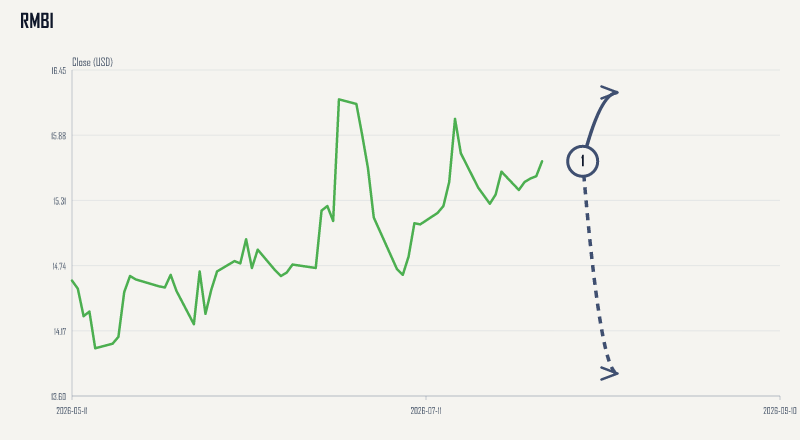
Management has historically navigated these waters well, utilizing a 37.6% historical net income growth rate as a durable buffer against required loss provisions. If the combined entity demonstrates that its underwriting holds up in an elevated rate environment, Scouter's catalyst modeling suggests the stock could drift toward a $16.25 bull target. Conversely, any unexpected localized property stress could force multiple compression back toward the $13.80 floor as the market reprices the loan book.
Paysign's operational leverage test
Paysign (PAYS) is scheduled to detail its second-quarter performance on Wednesday, August 5, 2026, offering a direct look at the payment rails powering the life sciences industry . After posting 50% revenue growth in the first quarter, investors expect the transaction processor to prove that operational leverage is definitively kicking in. The core thesis relies on the company efficiently scaling its top line across expanding healthcare affordability programs without a proportional spike in operating costs.
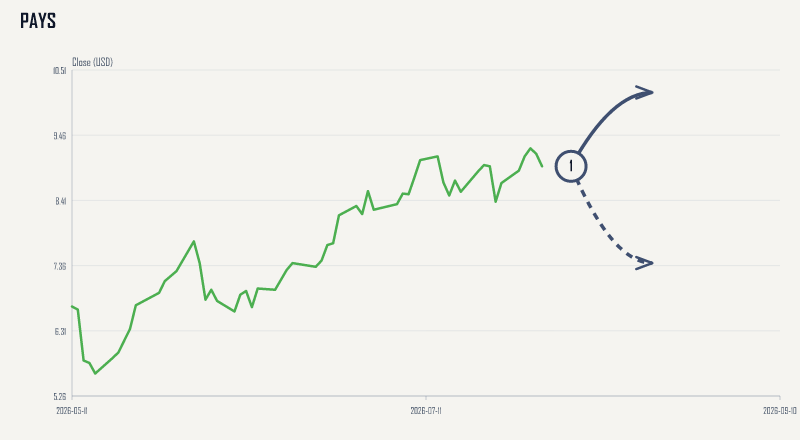
Expectations embedded in the current valuation are high, setting up a binary reaction based on management's forward visibility. A clean beat-and-raise scenario has the structural momentum to propel shares toward a modeled $10.15 target, rewarding the growth narrative. However, a slowdown in card load volumes or margin slippage would likely invite a harsh valuation reset, with downside models pointing toward $7.40 if growth investors de-risk.
Northfield Bancorp and NIM stabilization
Northfield Bancorp (NFBK) wraps up the week's banking prints when it reports second-quarter results on Friday, August 7, 2026. The core focus here is purely mechanical: investors want to see evidence of Net Interest Margin stabilization now that the 10-year and 2-year Treasury spread has un-inverted. The bank's core deposit costs should technically be better aligned with yields on new loan originations, but the speed of that transmission is what investors are watching.
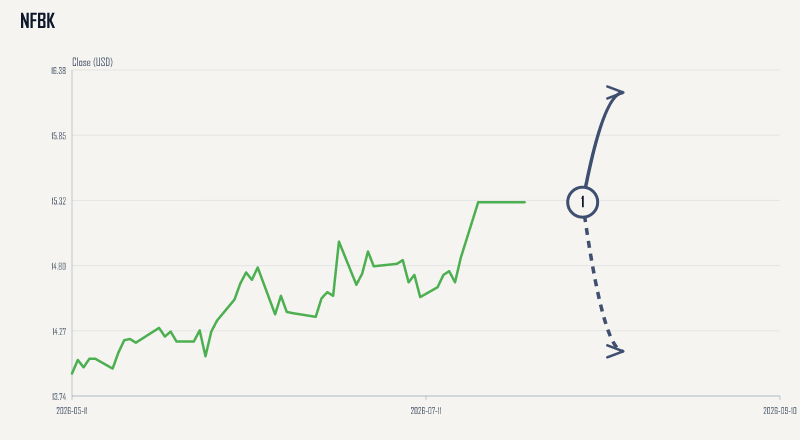
The fundamental backdrop is uniquely complicated by the bank's pending merger with Columbia Financial, with stockholders having recently navigated the July deadline to elect their preferred form of merger consideration . If Northfield demonstrates NIM expansion above consensus estimates, shares have room to run from their $15.25 base toward a $16.20 target. Persistent deposit beta pressures or softening loan demand, however, risk a localized contraction toward the $14.10 floor.
Pricing the execution premium
This week's slate highlights a market that is no longer universally punishing or rewarding financial entities based purely on the direction of Fed funds. Instead, capital is aggressively flowing toward idiosyncratic execution: banks that successfully manage loan provisions through M&A transitions, and fintechs that can scale software margins over payment rails.
The volatility profiles across these three names suggest investors are willing to pay a heavy premium for clarity. Whether it is parsing out merger-integrated balance sheets or tracking pharmaceutical payment volume, the expected moves confirm that the market is prepped for sharp repricing the moment the underlying unit economics diverge from consensus.