
Low Earth Orbit (LEO) has quietly graduated from venture-backed science fiction to a core commercial and geopolitical chokepoint. The bleeding of private space-market sentiment into public tech megacap valuations over the last week—combined with high-stakes geopolitical disputes over terrestrial satellite access—signals a regime change. Orbital logistics are actively moving terrestrial equity markets.
Advances in launch technology and standardized satellite design have structurally lowered costs, allowing commercial actors to colonize orbital infrastructure . With 109 countries having launched at least one satellite by the end of last year, barriers to entry have collapsed under the weight of commercial procurement and rideshare deployments . Space is no longer a sandbox for billionaires; it is the physical layer of the next global data economy.
The Commercialization of the Void
Public markets are being forced to price privatized space networks as foundational infrastructure. Because the dominant launch provider remains private, investors are aggressively hunting for derivative exposure through the data aggregators, hardware suppliers, and legacy aerospace names that manage the Space Economy transmission mechanism.
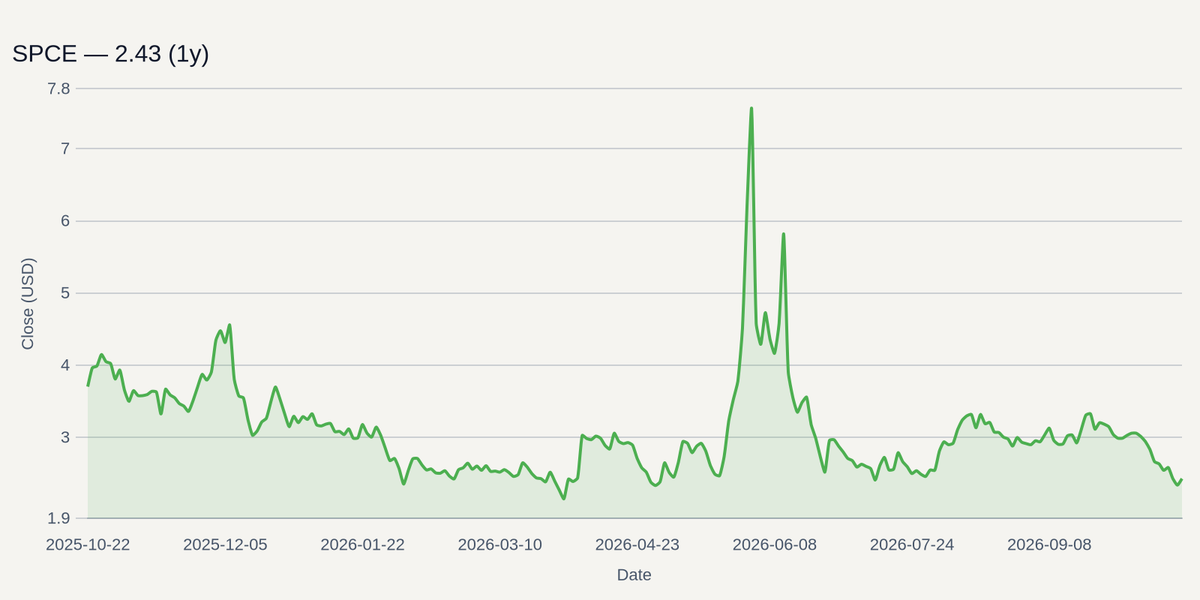
Private capital and falling launch costs have permanently reshaped unit economics for orbital logistics . But operating beyond the atmosphere remains wildly capital intensive. For early commercial proxies like Virgin Galactic, hardware milestones dictate survival. The company faces crucial flight testing ahead of a targeted commercial debut for its next-generation Delta vehicles in early 2027. Verifiable success could trigger a speculative bid toward the $2.45 modeled target. Conversely, supply chain friction or engineering setbacks would immediately reignite cash burn anxieties, threatening a sink to structural lows around $1.40 as investor patience exhausts.
The Silicon Backbone
Orbital arrays are useless without the terrestrial compute to process their data. The capital expenditure wall required to build out ground-station infrastructure and satellite communication systems heavily involves legacy semiconductor manufacturers trying to pivot into high-margin enterprise AI and defense contracts.

Intel sits squarely in this transmission channel. The company supplies the underlying technology for massive satellite communication systems, but its balance sheet is walking a tightrope. Heading into its Q3 print on October 29, the capital structure presents severe jump-diffusion risk. With trailing interest coverage hovering at a dangerously low 0.07x, heavy ongoing CapEx limits free cash flow.
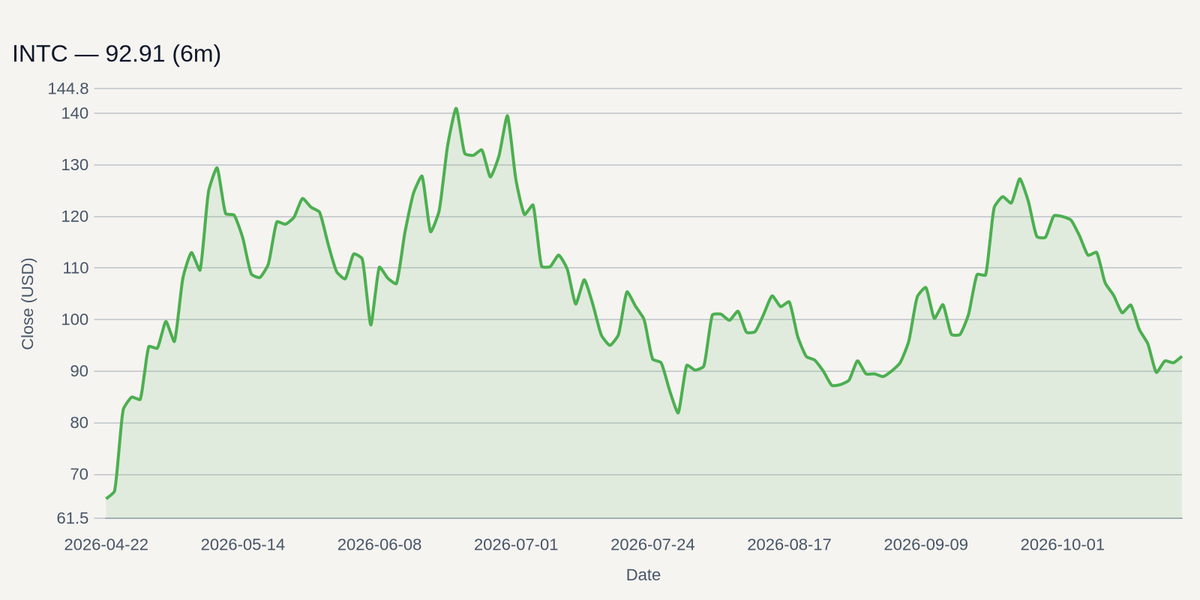
The base case for Intel remains adverse: any miss on Data Center AI margins will likely overshadow top-line growth, pulling the stock down toward a modeled $82.00 fallback. Management has to deliver a pristine beat and raise to justify a rerating toward the $122.00 target and prove that its massive infrastructure investments are actually yielding durable enterprise traction.
Bending the Orbital Cost Curve
The most acute risk to the commercial LEO narrative is simple commoditization. As deep-pocketed competitors and defense primes deploy advanced multi-sensor platforms, niche data providers must prove their moats are defensible.
Earth observation players are facing the ultimate test of their unit economics. Companies operating in this space—like pure-play earth imager Planet Labs—will use their upcoming earnings prints to reset long-term margin expectations. For Planet Labs, the focus heading into December is whether revenue growth can outpace the heavy operational expenditure required to maintain its constellation. If they can confirm the cost curve is bending toward self-funding growth, modeled targets suggest a run toward $33.00. But if opex re-accelerates and losses widen, the stock could slip back toward its 52-week low near $10.50 as investors balk at ongoing constellation maintenance costs.
Ultimately, the maturation of orbital infrastructure means the market is no longer paying for the novelty of launch. The alpha has moved downstream to the companies capturing, processing, and monetizing the data flowing back to Earth.