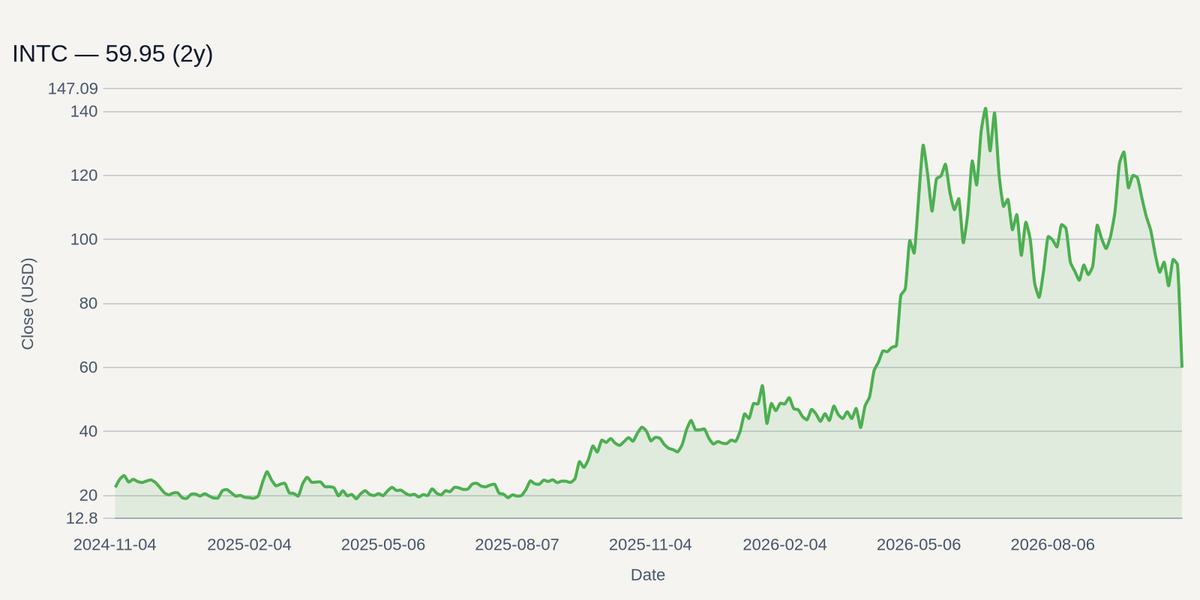
Friday's broader market technology rout wiped out roughly $400 billion in a single session, but the true structural breakdown is hiding in the wreckage of a single legacy incumbent. Intel just suffered its worst single-day drop since 1974, losing nearly 29% of its value last week and effectively halving its market capitalization since September . While the headline indices point to a $3.7 trillion tech correction tied to mega-cap cash flows, the bloodbath in legacy silicon exposes a much harsher reality. The industrial turnaround narrative for domestic chip manufacturing is collapsing under the weight of its own unit economics.
The Capital Furnace of Domestic Fabrication
The fundamental flaw: Intel isn't just trying to design competitive client processors; it is attempting to construct the physical infrastructure to print them on U.S. soil. This dual mandate is a brutally expensive endeavor that is cannibalizing the company's free cash flow. Bootstrapping a competitive third-party foundry to rival Asian incumbents requires a level of capital intensity that traditional enterprise revenues can no longer subsidize.
The mechanical reality: Building a modern semiconductor fabrication facility is essentially erecting a bespoke $20 billion printing press that requires constant technological overhaul. When you are the undisputed market leader, scaling those fixed costs across massive volumes makes the unit economics sing. When you are losing client market share and struggling to attract major external partners to your new nodes, every silicon wafer produced becomes a financial liability . The market's violent repricing reflects a realization that capital destruction is currently a feature, not a bug, of this transition.

Yield Bottlenecks and the 18A Mirage
The transmission channel: The entire bullish thesis for Intel's foundry business rests on the successful scaling of its flagship 18A process node. Getting a next-generation node to function in a lab is an engineering triumph; getting it to yield profitably at commercial volume is an industrial gauntlet. If defect rates remain too high, the cost per functional die destroys any pricing power the foundry might have had with potential external customers.
The policy cross-currents: Washington is aggressively attempting to cushion this blow, but the regulatory cross-currents are fierce. Milestone-based tranches for Semiconductor Manufacturing funding under the CHIPS Act were designed to provide a critical liquidity bridge for domestic build-outs. Yet, the government is simultaneously tightening the screws through ongoing export control expansions . U.S. industrial policy is subsidizing domestic fabs while systematically choking off their access to key overseas end markets.
Pricing the Silicon Bifurcation
The structural divide: The gap between pure-play fabless designers and legacy turnaround projects is widening into a permanent chasm. The market is happily awarding premium multiples to companies that design chips and outsource the capital-intensive manufacturing, while viciously punishing those forced to pour concrete and buy physical lithography tools.
The coiled spring risk: The obvious threat to this terminal-decline thesis is the sheer compression of Intel's valuation. Trading at distressed multiples following the sharp selloff from its late-October Q3 earnings print, the stock sits heavily coiled (with Scouter modeling a base catalyst target of $73.67). If management successfully secures a marquee fabless customer for the 18A node and seamlessly integrates pending federal funding disbursements, a resulting relief rally could push shares back toward Scouter's modeled $89.63 bull target for early 2027.
For now, however, the burden of proof rests entirely on the foundry floor. The broad-market tech correction may eventually reverse on macro tailwinds, but the domestic fabrication premium is gone. Investors are no longer willing to underwrite the cost of America's silicon independence blindly.